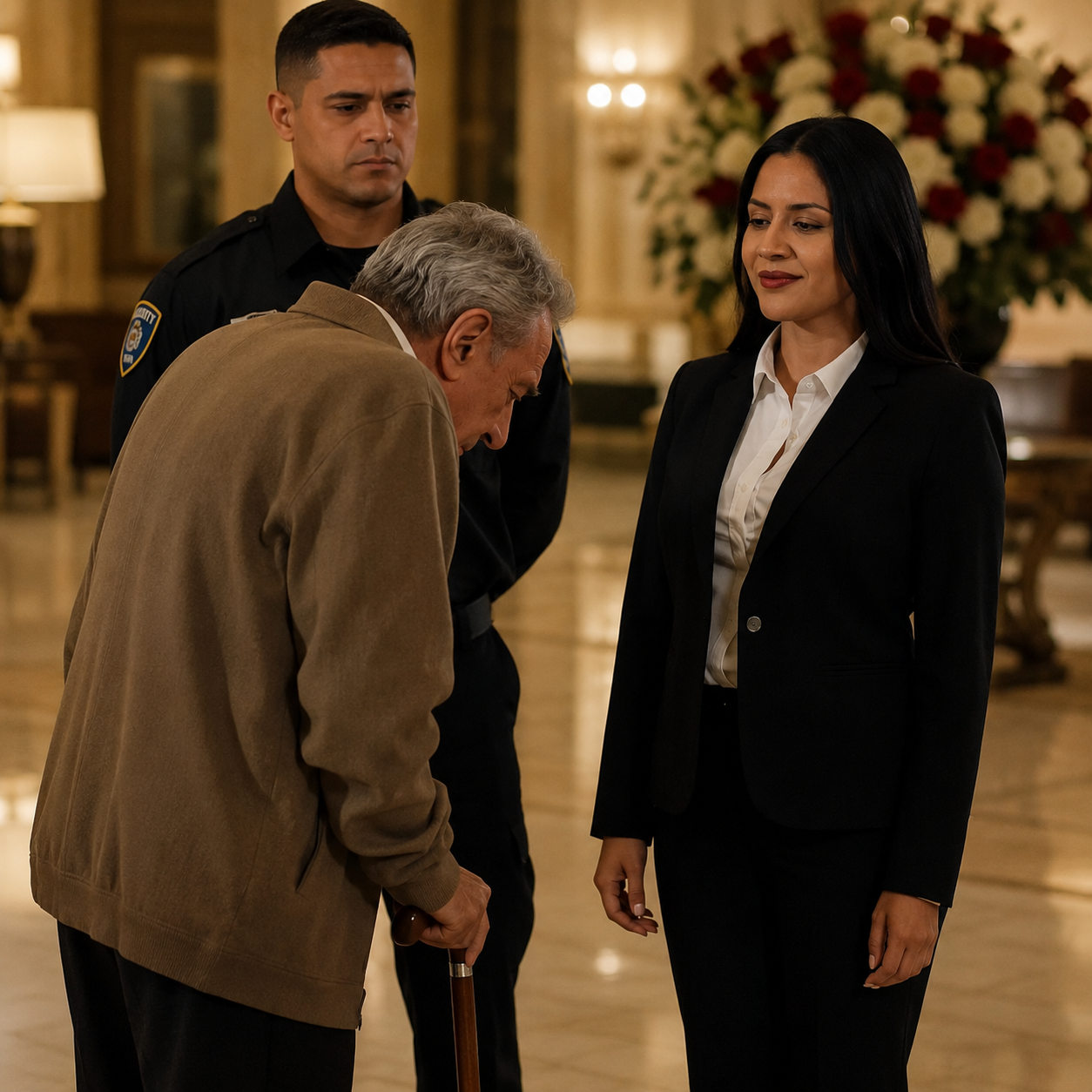
43IDPH “They Humiliated the New Employee in Front of Everyone… But Ended Up Embarrassing Themselves!”

Posted Jun 4, 2026

The executive elevator doors opened like a long-awaited judgment finally arriving. The General Director stepped out slowly, yet every footstep across the polished floor seemed to make the air in the entire office heavier. No one spoke. Even the sounds of keyboards and printers gradually faded, as if the entire floor had been forced to bow beneath the weight of her presence. Everyone stared at the woman approaching—well-dressed, cold-faced, and completely silent—yet her silence felt far more terrifying than any scream of anger. The moment the manager saw her, her face instantly turned pale. The hand that had been striking moments earlier suddenly trembled, and the lips once so used to insulting others could no longer form words. The young employee remained standing beside the desk, a bruise on her forehead and redness on her cheek, but her gaze stayed straight, calm, and steady.

The General Director stopped in front of her daughter. Slowly, she examined the bruise on her forehead, the trembling hands, and the flushed cheek. She did not cry. She did not ask questions immediately. Only a cold silence came from her, and that silence weighed heavily on the conscience of everyone who witnessed the scene. Then she turned toward the manager. “How many times have you done this before?” she asked, her voice low but sharp as a knife. The manager could not answer right away. She swallowed hard, forced a weak smile, and tried to explain. “Ma’am, it was only discipline. She’s new, so she needed—” But before she could finish, the General Director raised one hand. Everything stopped. “Discipline?” she repeated coldly. “That is called abuse. And you did it in front of the entire office.”

That was the moment the manager’s courage finally collapsed. The employees who had been laughing and clapping earlier lowered their heads one by one, terrified of being implicated. The General Director ordered security and the HR head to come forward immediately. “Get the CCTV footage. Now,” she commanded. One staff member quickly ran to the security room while the HR head, visibly trembling, opened a tablet and laptop. On the monitor, everything replayed again: the manager grabbing the young employee by the hair, smashing her head toward the keyboard, the loud slap, the laughter of coworkers, and the arrogant expression on the manager’s face as she flaunted her power. No one could look directly at the screen. The manager staggered backward, tears forming in her eyes—not out of remorse, but because she realized there was no escape left for her. “Ma’am, please forgive me,” she said shakily. “I didn’t know she was your daughter.” The General Director slowly turned toward her. “That’s the problem,” she replied coldly. “You thought you could hurt someone as long as they weren’t powerful.”

At that very moment, the manager’s access card was deactivated. Her company ID, laptop, and every official document under her name were confiscated. She was not even allowed to return to her desk alone; security escorted her while she shakily collected her belongings in front of the entire office. The employees who had laughed earlier were also summoned one by one by HR for disciplinary investigation. Some cried, some begged, but none of them could escape the CCTV evidence. The General Director announced to the entire team that the manager was immediately suspended pending formal investigation, and because the evidence of assault, abuse of power, and workplace harassment was undeniable, she would be permanently terminated and face legal complaints. The once arrogant woman who believed she ruled the office now stood with her head lowered, carrying a small box of belongings while the same people who once applauded her cruelty were now too afraid to even look at her.

Before leaving, the manager stopped in front of the young employee. The arrogance on her face was completely gone. In a broken voice, she whispered, “I’m sorry.” But the young employee did not smile or show pity. She simply looked straight at her and calmly said, “Sorry is not enough when you use your position as a weapon.” The manager lowered her head, unable to answer. As security escorted her out, the General Director turned toward the entire office and said in a cold but clear voice, “From this moment on, no rank, title, or position will ever be used as an excuse to destroy another employee’s dignity.” Everyone remained silent. In the final moment, the mother walked toward her daughter, gently placed a hand on her shoulder, then looked at the remaining employees. The silence in the office was no longer only the silence of fear—it was the silence of shame, of lessons learned, and of a power finally used not to hurt others, but to hold the guilty accountable.


Comments (0)

Loading comments...

48USPH She Humiliated an Elderly Woman on the Bus… But the Ending Made Everyone Shocked
The entire bus became painfully silent after the man in the suit shouted. The teenage boy sat frozen in his seat, his mouth slightly open, but no words came out. The students who had been laughing only seconds before slowly lowered their phones, their faces turning pale as they looked from the man in the suit to the elderly woman still lying on the dirty bus floor. The man rushed forward and carefully knelt beside her, his anger turning into deep concern. “Ma’am, please don’t move too fast,” he said gently, helping her reach for her fallen crutch. The elderly woman tried to smile through the pain, but her hands were shaking badly. The man looked up at the passengers around him, his voice cold and disappointed. “All of you saw her fall. And not one of you helped her.” No one answered. The only sound left was the heavy rumble of the bus engine and the soft, embarrassed breathing of the people who had pretended not to see. The teen boy finally forced himself to speak, but his voice had lost all confidence. “I… I didn’t know who she was,” he muttered. The man in the suit slowly turned his head toward him. His eyes were sharp behind his glasses. “That’s your excuse?” he asked. “You needed to know she was someone important before you treated her like a human being?” The boy swallowed hard, gripping the edge of his seat. His friends stepped slightly away from him, as if they suddenly did not want to be connected to him anymore. The man pointed toward the elderly woman and said, “This woman is Margaret Whitmore. She founded the scholarship program that pays tuition for half the students at your private school. She donated the new library, the science building, and the disability access fund your school proudly brags about every year.” The words hit the bus like thunder. The boy’s eyes widened even more. One of the students whispered, “No way…” while another slowly covered his mouth, realizing that their cruel joke had just turned into something far more serious. The elderly woman was helped into a nearby seat by the man in the suit and two passengers who finally found the courage to move. Her injured leg trembled as she sat down, but her face remained gentle, almost heartbreakingly calm. She did not look at the boy with hatred. She looked at him with sadness. That sadness made him feel smaller than any punishment could. The man in the suit stood beside her and took out his phone. “I’m calling the school board,” he said firmly. “And I’m requesting the bus security footage, along with every video your friends recorded.” The students panicked. Several immediately tried to hide their phones, but the man’s voice cut through them. “Deleting evidence will only make this worse.” The teen boy’s face collapsed completely. His arrogance, his lazy posture, his cruel smile—all of it disappeared. He slowly stood up from the seat he had refused to give, but now the seat felt like a throne of shame he no longer deserved. The boy stepped toward the elderly woman, his voice cracking. “I’m sorry,” he whispered. “I didn’t mean…” But he stopped, because even he knew that was a lie. He had meant to humiliate her. He had meant to make his friends laugh. He had meant to feel powerful by making someone weaker fall. The elderly woman looked up at him, her eyes wet but steady. “Young man,” she said softly, “being strong does not mean pushing down someone who can’t stand easily. It means helping them up when no one else will.” The boy lowered his head. For the first time, he looked like a frightened child instead of a reckless bully. Around him, the students who had filmed the fall looked down in shame. A few passengers who had stayed silent also avoided the woman’s eyes, realizing they were not innocent either. Their silence had protected cruelty until someone powerful finally spoke. The bus slowed to the next stop, but no one rushed to get off. The man in the suit remained standing near the elderly woman, still on the phone with the school. The teen boy stood in the aisle, surrounded by the judgment of everyone who had just witnessed the truth. His friends no longer laughed. Their phones were no longer weapons; now they were proof. The elderly woman held her crutch again, breathing slowly, her dignity untouched despite the humiliation. Before the doors opened, she looked at the boy one last time and said, “I hope one day, when you are weak, someone treats you better than you treated me.” The boy’s eyes filled with tears, but he could not answer. The bus doors opened with a loud hiss, sunlight spilling across the floor where she had fallen. The final image holds on the boy’s terrified, ashamed face as he realizes that one cruel moment may cost him his school, his reputation, and the future handed to him by the very woman he called a burden.

Us