56USPH “Mocking and Kicking a Soldier Came With a Price He Never Expected!”

Posted Jun 4, 2026

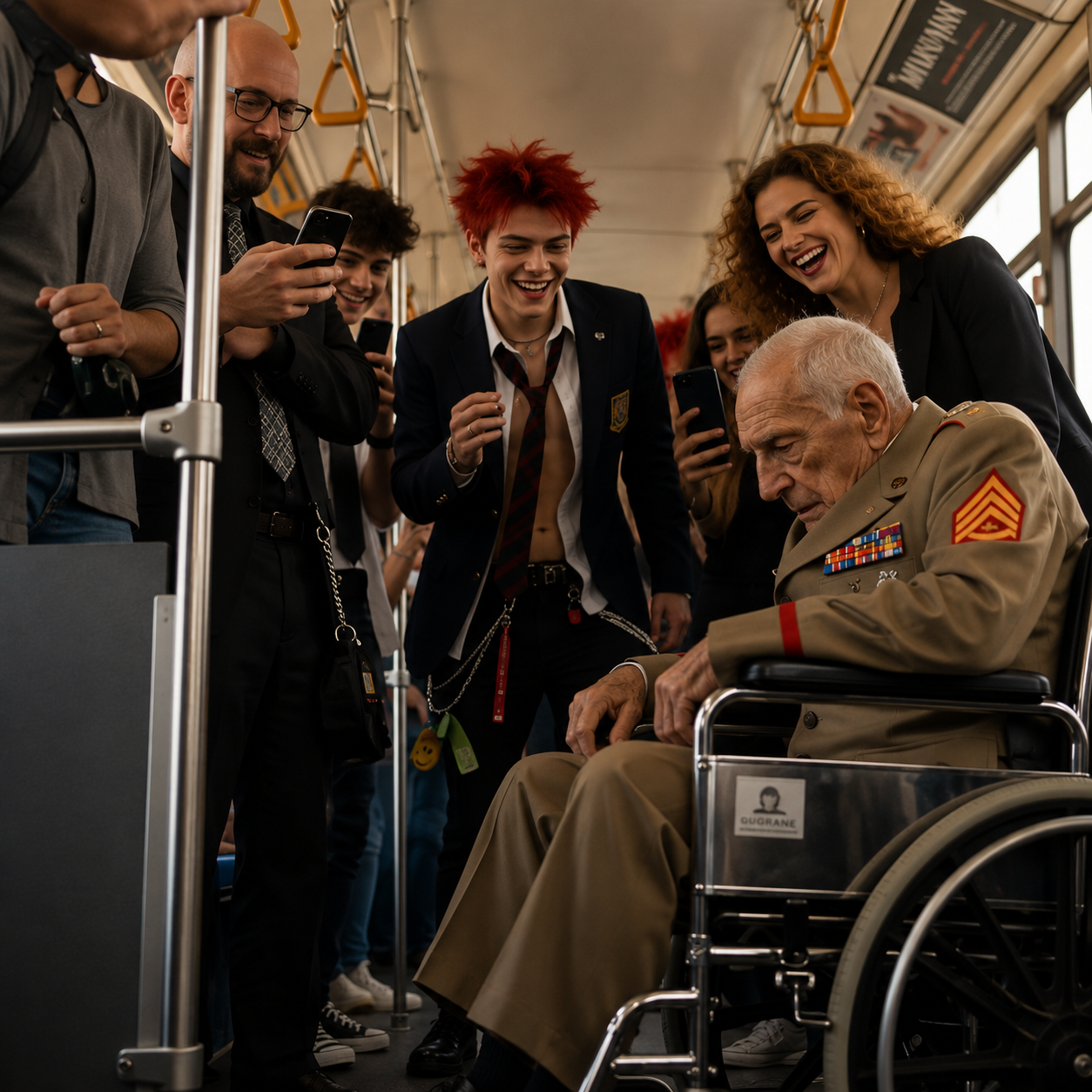
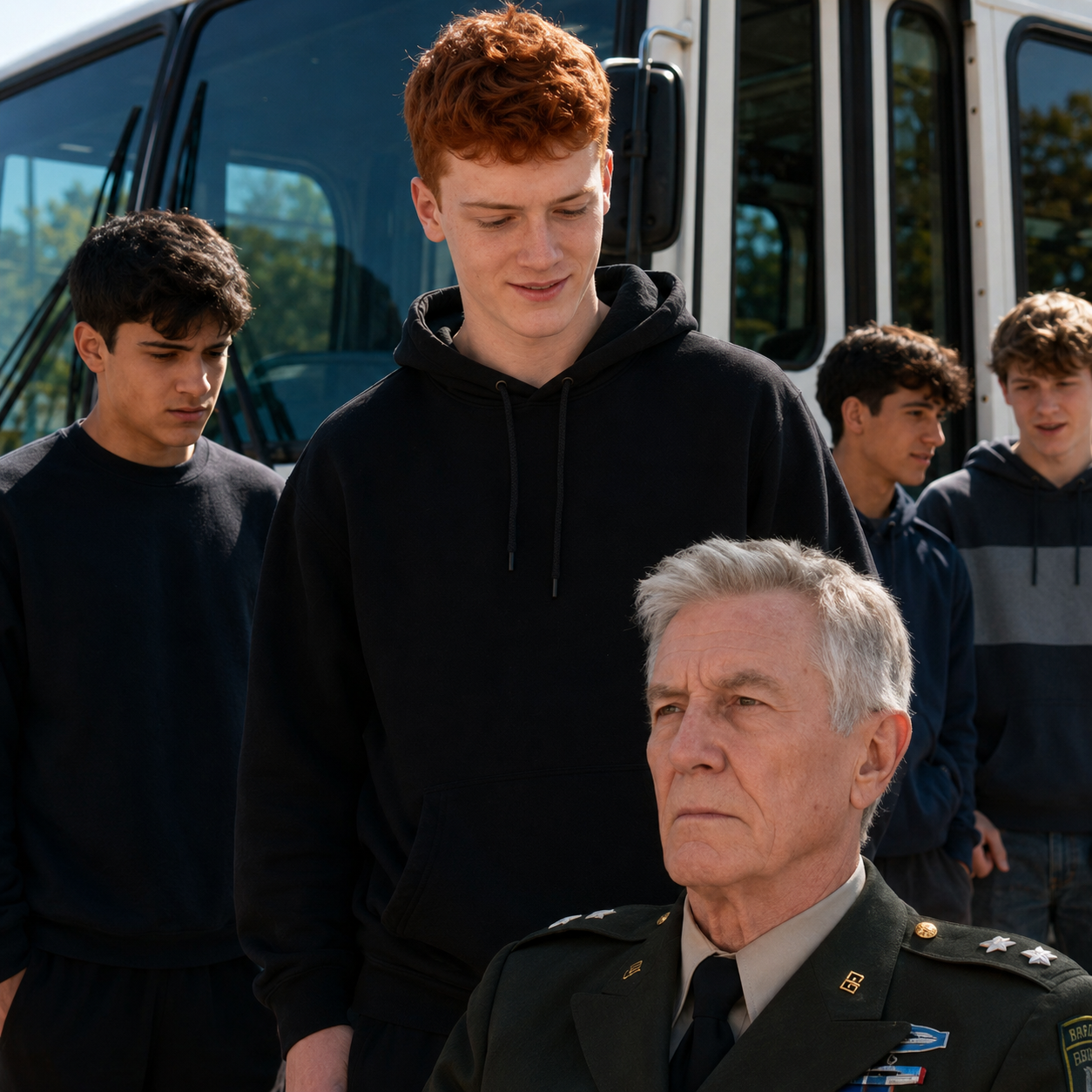
The entire bus froze after the laughter died. The red-haired student who had been standing arrogantly in the aisle suddenly could not move, still holding the unlit cigarette in his hand as it trembled between his fingers. His friends, who had been laughing and recording moments earlier, slowly lowered their phones one by one, their faces turning pale with fear. On the bus floor, the elderly veteran was carefully supported by the man in the suit, who helped him sit up and pulled the wheelchair back after it had been knocked aside by the kick. No one spoke for several seconds. Only the rumble of the engine, the faint rattling of the bus, and the heavy breathing of the passengers could be heard. The once hot and noisy bus suddenly felt like a courtroom, where everyone who had witnessed the cruelty knew there would be a serious price to pay for the reckless boy’s disrespect.

The man in the suit slowly looked at the red-haired student. He did not shout, but the coldness in his eyes was enough to make the boy step back slightly. “Do you know who you just kicked?” he asked in a heavy voice. The student could not answer. He swallowed hard, but it felt as if something was stuck in his throat. The man in the suit looked at the elderly veteran, then turned his gaze back to the boy. “The man you laughed at,” he said clearly, “is a former soldier. A father who raised a son who is now the police chief. An old man who has sacrificed more for this country than you could ever understand.” The silence grew even heavier. Some passengers lowered their heads, not only because of what the student had done, but because of their own silence while the bullying was happening.

The red-haired student slowly tried to stand, but his knees were shaking. “Sir… I didn’t know,” he said weakly, almost in a whisper. The man in the suit’s face hardened. “You didn’t know he was the police chief’s father?” he asked. “Or you didn’t know he was also a human being?” The boy had no answer. The question hit harder than any shout. Behind him, the friends who had pushed their phones closer to the elderly man now stood silently, terrified that they would be involved too. One of them slowly tried to slip his phone into his pocket, but the man in the suit immediately shot him a sharp look. “Don’t delete the video,” he said. “Because if you thought this was just a game, now you’re going to learn what accountability means.”

Moments later, the sound of approaching sirens echoed from outside the bus. The red-haired student’s face turned completely pale. The cigarette in his hand nearly fell. The bus driver slowly pulled over to the side, while the passengers remained silent, almost afraid to move. The front door opened, and several police officers quickly entered. Behind them came the police chief—tall, serious, and visibly holding back his anger. He did not look at the boy first. The first thing he did was kneel beside his father. “Dad…” he said softly, his voice trembling as he tried to control his emotions. He carefully held the old man’s hand, and in that moment, everyone saw that this was not only an officer who had arrived—this was a son who had come for the father who had been humiliated.

The police chief slowly stood and faced the red-haired student. He did not shout. His quiet anger was far more frightening. “You were brave earlier,” he said in a low voice. “Kicking an old man. Laughing at someone lying helpless on the floor. Recording it for fun.” The boy was trembling now, unable to look him in the eye. “Sir… I’m sorry,” he stammered. But the police chief’s expression did not change. “Your apology should not start with me,” he replied. The boy slowly turned toward the elderly veteran, dropped to his knees in the aisle, and nearly cried as he bowed his head. But the bus remained silent, because everyone knew an apology was not enough to erase the humiliation he had caused. As the police collected the phone videos as evidence and questioned the students, the elderly veteran was placed back into his wheelchair. The final image inside the bus was the red-haired student bowing his head, his arrogance destroyed, as the cigarette in his hand finally fell to the floor—along with the false courage he once thought could never be broken.
Comments (0)

Loading comments...

46USPH “Mocking and Kicking an Elderly Man Cost Her More Than She Expected!”
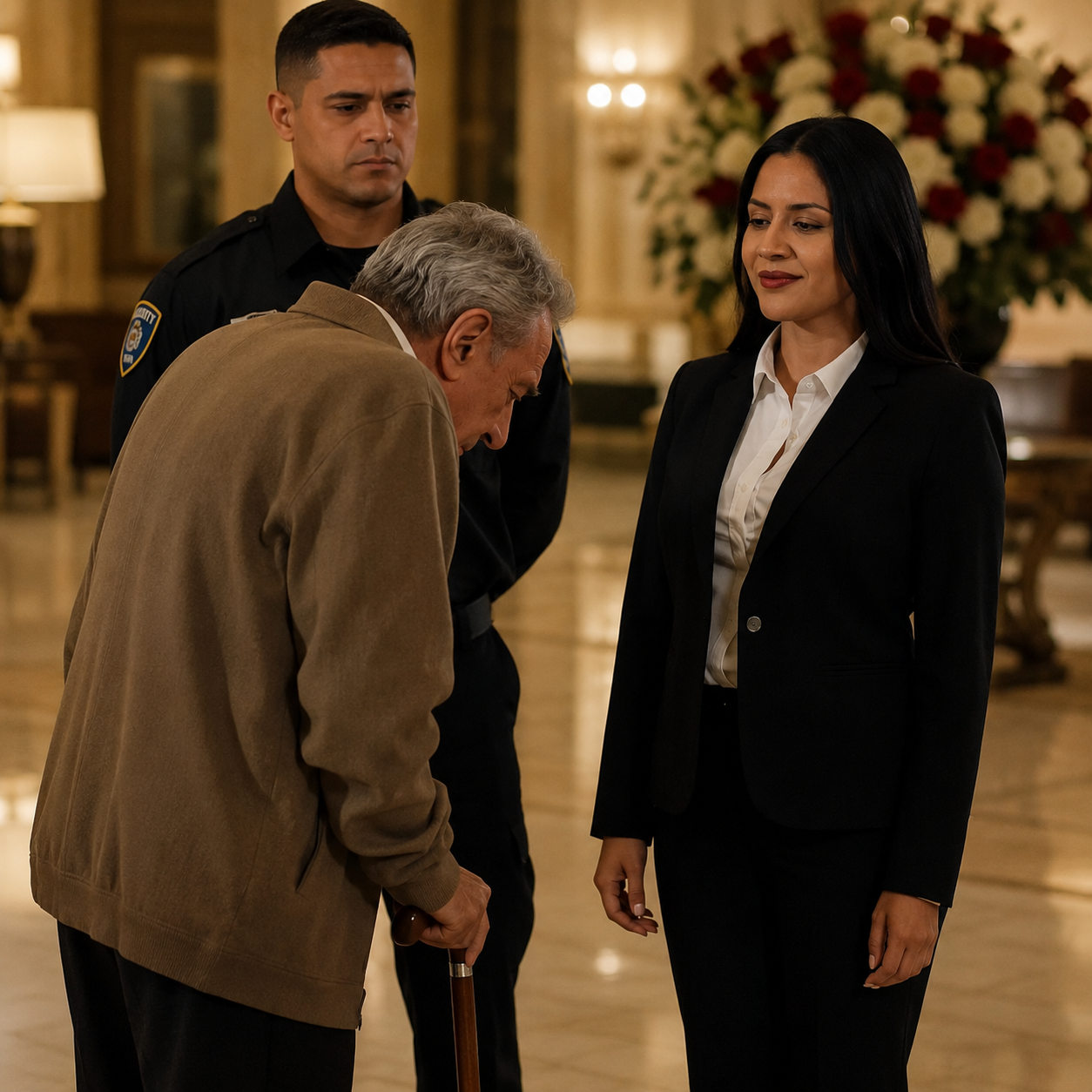
The suited executive wrapped one arm carefully around the elderly man’s shoulders and helped him rise from the cold marble floor. The chairman’s hand trembled slightly as he reached for his cane, but his face remained calm, almost painfully calm. That silence was heavier than anger. The entire lobby seemed to stop breathing. The distant piano faded into nothing. Glasses stopped clinking. Guests who had been whispering now stood frozen, their eyes fixed on the old man they had mistaken for someone unimportant. The female manager stared at him in horror, her lips parted, her polished confidence breaking apart piece by piece. Only a few seconds earlier, she had stood over him like he was dirt on her marble floor. Now the most powerful executive in the building was bowing his head to him and calling him “Chairman.”The elderly man slowly straightened his back. Though his body looked weak, his presence suddenly filled the lobby. He did not need an expensive suit. He did not need a loud voice. Every person there could feel the authority in his silence. He turned his eyes toward the female manager, and she immediately looked down, unable to meet his gaze. Her hands shook at her sides. The security guard beside her swallowed hard and took half a step back, as if distance could save him from what he had allowed to happen. The chairman looked at the fallen cane, then at the manager’s expensive heels, then finally at her face. In a low, controlled voice, he said, “I built this hotel so people would feel respected the moment they walked through the door. And tonight, I learned that respect here has become something you sell only to the rich.” The manager’s face turned even paler. She tried to step forward, her voice cracking as she forced out an apology. “Sir, please… I didn’t know it was you. I swear, if I had known—” The chairman raised one hand, stopping her before she could finish. His expression did not change, but his words cut through the lobby like ice. “That is exactly why you are standing here in shame,” he said. “You are not sorry because you hurt an old man. You are sorry because the old man turned out to be someone powerful.” No one moved. The executive lowered his head deeper, ashamed that such cruelty had happened under his watch. The guests looked at the manager with disgust now, the same way she had looked at the chairman moments before. The cruelty she had displayed had returned to her in full view of everyone. Then the chairman slowly turned to the security guard. The guard stiffened, his face tense with fear. The chairman’s eyes were tired, but sharp. “Your uniform does not exist to protect pride,” he said. “It exists to protect people.” The guard’s jaw tightened, but he could not answer. He had watched an elderly man fall and had done nothing. The chairman then looked toward the executive and gave a calm order. “Secure the security footage. Contact human resources. Remove them both from duty immediately. I want a full investigation by morning.” The female manager shook her head in panic, tears filling her eyes as she realized the life she had built inside that hotel was collapsing in front of the very guests she had tried to impress. “Sir, please, I have worked here for years,” she whispered. The chairman looked at her one final time and replied, “Then you had years to learn dignity.” The lobby remained silent as two senior staff members stepped forward and quietly escorted the manager away from the center of the room. She no longer looked powerful. Her shoulders had fallen, her face was empty, and every step she took across the marble sounded like a judgment. The chairman stood with his cane in hand, breathing slowly, while the executive stayed beside him, afraid to let him stand alone. Before walking toward the elevator, the chairman turned slightly and looked across the lobby at every guest and employee watching. His voice was soft, but everyone heard it clearly. “A hotel is not judged by how it treats billionaires,” he said. “It is judged by how it treats the person it thinks has nothing.” Then he walked away, cane tapping against the marble with steady rhythm. Behind him, the lobby stayed frozen, and the woman who had called him a broke old man was left with nothing but silence, shame, and the terrible truth that the man she tried to throw out owned everything around her.

Us