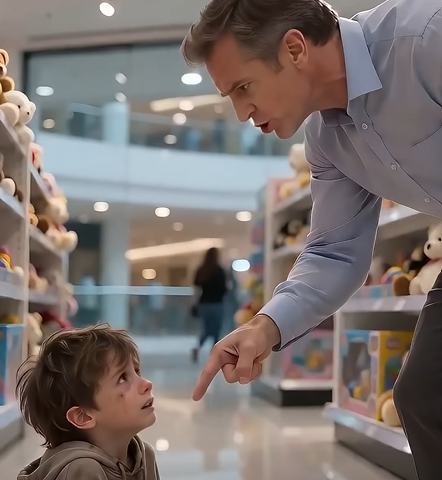
The little girl’s hand shook, but her eyes stayed firm as she unlocked the phone and turned the screen toward the wealthy store owner. “I was filming the big teddy bear for my mom,” she said, breathing fast. “But I recorded everything.” The owner snatched the phone and stared at the video. On the screen, the crowded toy aisle appeared from a child’s angle. The footage clearly showed his wallet slipping halfway out of his coat pocket as he turned. A second later, the elegant woman stepped close behind him, glanced around, and with a smooth motion pulled the wallet free. A shocked murmur spread through the toy store. The homeless boy, still on the floor, stared up through tears. The woman’s face lost all color.
The video did not stop there. In the next few seconds, the elegant woman moved quickly toward the toy display where the homeless boy had been standing. She crouched as if looking at a toy, then slid the wallet underneath a lower shelf near him before straightening up and stepping back into the crowd. A few moments later, the owner appeared on the screen, noticed his missing wallet, and turned toward the nearest target—the frightened little boy. The entire store fell into dead silence. The little girl swallowed hard and pointed at the screen. “He didn’t steal anything,” she said. “She took it, and then she left it there so everyone would blame him.”
The elegant woman suddenly stepped backward, forcing a stiff laugh that sounded completely hollow now. “That proves nothing,” she snapped. “A child could misunderstand what she saw.” But her voice was no longer steady. The wealthy store owner looked from the video to her face, then down at the shaking boy on the floor. His expression cracked. He had been so certain, so loud, so cruel—and now every pair of eyes in the toy store was on him. The homeless boy’s chest rose and fell sharply as he tried to stop crying. The owner bent down, reached under the shelf, and pulled out the wallet with trembling fingers. He opened it. Everything was still inside.
Then the little girl spoke again, more urgently this time. “There’s more.” She took the phone back, swiped to another clip, and played it. The second video had started only seconds later, after she had grown suspicious. In it, the elegant woman could be seen whispering angrily into her own phone near the end of the aisle: “I almost had it. If the owner had called the police on the boy, no one would have noticed me.” Then she opened her luxury handbag just enough for the camera to catch several boxed toys with torn-off security tags hidden inside. A collective gasp rolled through the crowd. What had looked like judgment and class suddenly turned into something colder—disgust.
The wealthy store owner’s face turned red with shame and fury. He slowly released the boy and took one step toward the elegant woman, but this time his voice was no longer arrogant—it was stunned and heavy. “You used a child to cover your own theft?” he asked. The woman looked around wildly, hoping someone would defend her, but no one moved. The homeless boy pushed himself upright with trembling hands. Mud and dirt stained his clothes, tears streaked his cheeks, and his whole body still shook from fear. Yet even then, he looked less broken than the woman who had tried to destroy him. The little girl went to stand beside him, clutching her phone like a shield.
The elegant woman suddenly tried to run. She turned sharply toward the glass storefront, but mall security officers—already alerted by the commotion—rushed in from both sides and blocked her path. One of them took the phone from the little girl and watched the footage with the store owner. Another opened the woman’s bag and found the stolen toys inside, along with a second wallet that did not belong to the owner at all. The toy store erupted in whispers. The woman’s polished image shattered in an instant. She had walked in looking like the richest, most respectable person in the room, yet she was the real thief. And the smallest, poorest child there had been the one blamed for it.
The store owner slowly turned back to the homeless boy. For a long moment he said nothing. Then, in front of the entire store, he knelt down to the boy’s eye level. His voice was rough with guilt. “I was wrong,” he said quietly. “I hurt you before I knew the truth.” The boy’s lips trembled, and he looked at the floor, not knowing whether to trust what he was hearing. The little girl gently took his hand. All around them, the shoppers who had judged him so easily now lowered their eyes in silence. The camera held on the owner’s ashamed face, the crying boy’s stunned expression, and the brave little girl standing between them. In one brutal afternoon, the richest adults in the store had been exposed—not by power, not by money, but by the truth in a child’s hands.